Showing posts with label Travel Journal. Show all posts

Sunday, November 8, 2020

Roads, Rocks, and Rampage

    We began our day on Nov. 1st out in the wilderness by a water body with thin fog seeming to rise from the still water. Just behind the lake was a small hillock and from somewhere out of sight, a Grey francolin was singing away. The early winter morning brought a nip in the wind but nothing beyond tolerable. The air was fresh and almost certainly, our masks were taken off to fill our lungs with the clean air, still available as one moved away from the burgeoning city. At a distance, we could hear a sandpiper and a small blue kingfisher flew across the lake. Our destination was not the lake itself but the hillock which we were looking at. It was just about 6 in the morning and we wanted to go up the hill before the sun broke out.

A view of the Jalamangala lake and the hill (Please credit all photos in this post as: Seshadri KS. 2020)

Trekking up the Jalamangala fort    

Vidisha told me about this location a few weeks ago and we had not found the time or the courage to brave the outdoors considering how most of our fellow Indians are oblivious to the concepts of hygiene and personal space. Finally, we managed to get Kishan to go with us too and we headed off at 430 am, picking up Kishan along the way. As soon as we picked Kishan up, he gave us a banana and it was one of the varieties which are now rare in Bangalore. It’s the ashy variety (Boodi Baale) and the pulp is dense and delicious. Reminiscing the past and catching up, we were headed to Narayanagiri, just off of Ramanagara. The hill is a monolith and adjacent to it is the Jalamangala lake which was our first stop. The Mysore road looked like an alien land. With the road widening project underway, the entire stretch has been mowed down and widened. Driving in the dark, we reached our destination in under an hour and were wondering if we should start going up in the dark itself. But then, the sun slowly started to show up over the horizon and we could see people bustling about in the villages that we passed through.      

We had seen photos of the hill and it looked quaint and peaceful. We also saw accounts of how there is an off-road trail being made and that concerned us a little bit. However, when we got to the hill, we realized what it was. Ahead of us, four bikers were already there and as is typical of uncouth tourists, they were yelling and screaming for no reason. We waited for them to go so that we could drive peacefully and followed the road up the hill. The road was still being made- there was mud that was dug up and several JCBs were parked for the night. It was a badly designed road, probably engineered by a college dropout or an overenthusiastic builder. Our car went up to a point past the steep hairpin bends but at one point, the loose soil meant there was no traction and our underpowered car just gave up. In the past, I have had the experience of driving underpowered cars on steep slopes. Not in the mood to repeat that, we decided to slowly back up the car and park it in the nearest flat ground at a hairpin bend.

The newly being gouged out road. 

    While all this was happening, we could see how they had destroyed the scrub forest patch that had once covered the road. Presumably, this was a footpath before and was a trekking path. The view must have been scenic. We wondered who might have come up with such great plants to strip the place of its beauty. Blaming the ruling government came easy for me but then, there were no boards or details claiming who the culprits were. The entire swath of the hill was cut and boulders, the size of a large SUV were strewn across the path. We had to walk about half a kilometer to reach the monolithic rock and we could immediately see that new steps were carved where there were none. Again, the steps had been carved with no logic or measurement. By this time, the four obnoxious men were even more so and were huffing and puffing as they ambled up the stairs. To keep their mind occupied, they and had turned on a loud, out of tune, Tamil song via a blue tooth speaker. I was particularly irked because it was November 1st and the day people of Karnataka celebrate their language and culture by playing equally out of tune songs on blaring speakers in every locality. But I heard myself say that and figured there is no point and let it pass.  

The temple on top of Jalamangala fort

    Climbing the 400 odd stairs was not difficult. By the time we made it to the top, the sun was fully out and painted the landscape a dull grey yellow. As far as the eye could see, the rolling hills of granite were clothed in an ethereal haze. The brisk hike had made us hungry and we quickly polished off the food we had packed. The bird activity was almost nil on the hillock. A quaint looking temple surrounded by a few pagoda trees. We soon began to explore the hilltop and went around the contours and saw parts of the old fort wall. Evidence of people having camped, drunk, smoked, and perhaps partied was evident. We stopped occasionally to check out the plants that had sprung up, thanks to the good rainfall over the last few weeks. A pair of Hoopoe kept company by walking briskly on the rock and foraging for seeds or insects.

Such lush grass is hard to find in the plains!

Scenic views and impending doom

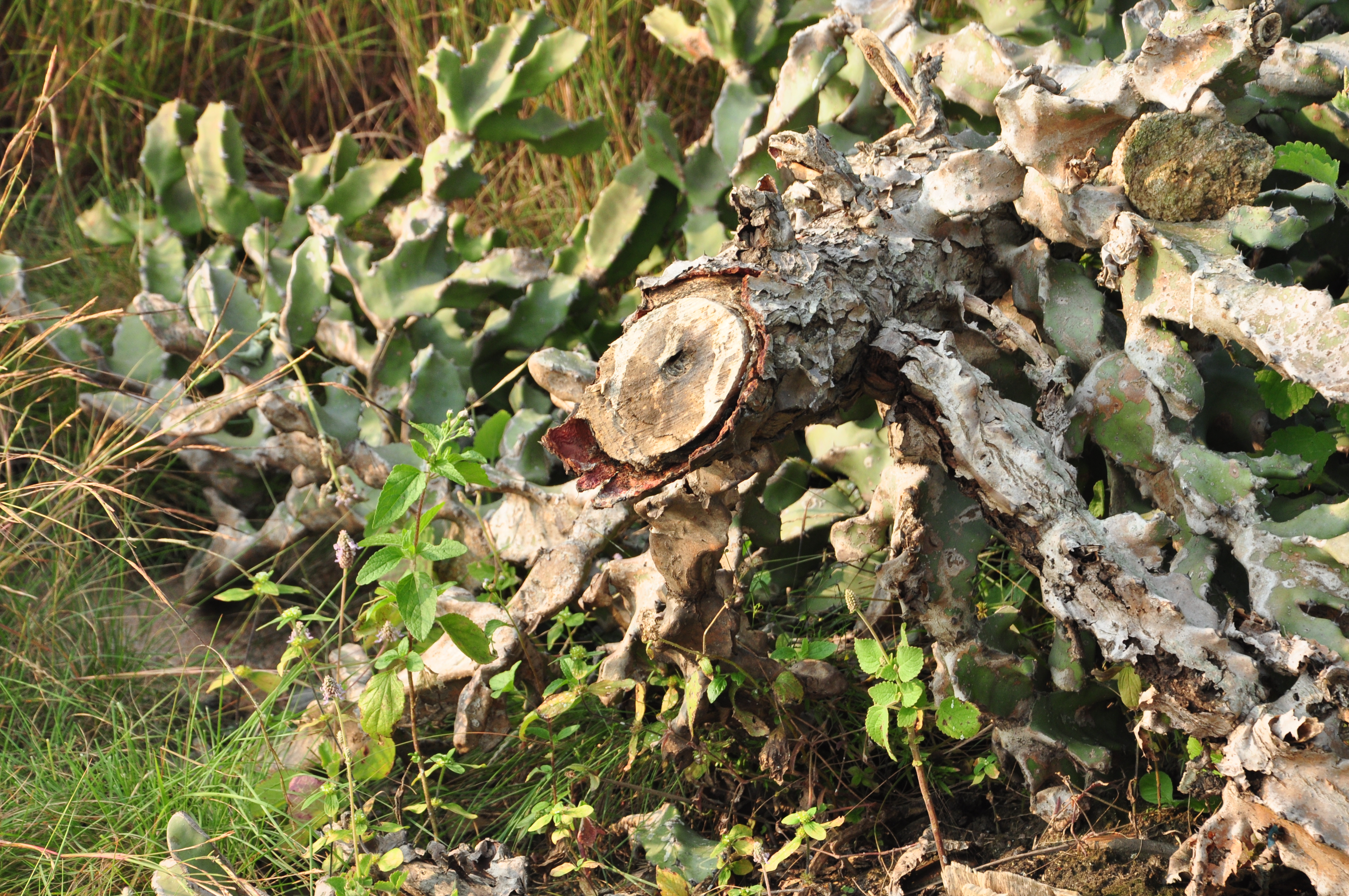
As we got around to the temple, we saw a ghastly sight. Someone had gone about cutting off the centuries-old Euphorbia that grows almost exclusively on such hillocks. We counted at least 15 plants that lay listless on the scorching rock. The plants are hardy and grow in places of little soil and are incredibly slow. Each one must have been easily over a few hundred years old and braved several storms and rain, only to meet their match in an ax-wielding biped. The patches of grass, making waves with the gentle wind were a sight to behold. Within this grass were several grasshoppers. I had not seen them in such a long time and in general, most insects are on the decline and no one knows why.  


The cut Euphorbia sp. These plants take years to grow. 

    As the day passed, we saw a few raptors take to the skies and they turned out to either be Booted eagles, Pariah kites or, a Brahminy kite. As the haze lifted, our line of vision expanded and we initially saw what looked like a large lake. Reorienting ourselves, we realized the lake we had stopped by was in another direction and when we looked carefully, it turned out to be a large expanse of the solar farm! Acres and acres of it. How much natural vegetation must have been cleared to plant these green forms of energy?

The solar farm

    We started to head back and stopped occasionally to watch more birds and by 9 am, more people had started to turn up. Huffing and puffing, they all walked past us, making plans for camping and partying. I even overheard one asking another if the god [deity] on top was Veg or Non-Veg! By this time, the construction crew had arrived and the JCB was being used to move the SUV sized rocks and throw them off the cliff to make the embankment of a parking lot stronger. The whole affair was saddening. The place was of inherent beauty and people were at work, destroying it.

This will become a new parking lot

Short sight or oversight?    

The approach road was blocked and I struck up a conversation with a man who looked like he was in charge. He seemed happy that we stopped by and kept coming close to us as we stepped back to keep our distance. We were masked but none of them were. He was one Mr. Venkatachala, a retired cop from a nearby village. I asked him about the road and he said it was a village panchayat effort and not a pisae from the government had been sanctioned. The project was done by their village people to get more tourists to visit the hill and enjoy the beauty. He also said they had the blessing of a retired Supreme Court judge. The temple on top was at least 400 years old he said. It is also a very powerful god, he added. I tentatively broached the subject of trees being cut to make the road, lest they take offence. But he did not. When I told him that the trees are probably older than their temple and they should not have cut it, he seemed surprised and called the JCB operator to tell him that I asked them not to cut the trees. We took some time to explain to them how these plants are unique to the rocky system and add to the beauty and they ought to retain it. He immediately went to the defensive and said that they cut down the trees only around the temple because people throw waste and break liquor bottles under the trees. “The tree squirts out milky latex and it is dangerous if it gets into the eye, if not, we would have cut them more”, he added.

The dug up area is apparently a water flow ditch to protect the slope from getting washed.

    “Look around, he said, we have only cleared the scrub jungle and not a single tree was harmed!”, he added. “Furthermore, I have planted many fruit trees where there was only rock and scrub around my village too,” said the proud man. We were anguished by the fact that the scrub jungle they bulldozed was the place most birds were sighted. The rare yellow-throated bulbul called the habitat it's home and it was now wiped out!

          Use the slider to see how the road has come up. 

As we came down to our parked car, we spotted several birds right around the disturbed patch. These included a beautiful blue-faced malkoha and a white-bellied drongo. Several dusky crag martins were flying about from a large cave and we were told that there was a family of bears in there. Occasionally, they spot a leopard too. The sun got too scorching and we decided to move on and spend the rest of the day.

This was the view we had breakfast with!

Kutagal and the eternal love
Our next stop was Kutagal. A scenic rock monolith with a lot of history. Folklore has it that two washer folk who could not get married went there to kill themselves but a sage turned them into a rock and they live forever, together.

A panoramic view of the Kutagal rocks.

    The place had a lot more people and we dodged them and walked along the rock. It was strewn with broken liquor bottles, party poppers, as well as general plastic trash. The forest department had a board saying don’t litter the place but there was not a soul regulating or enforcing the rules. The villagers at the gate charge a fee for entry and that’s it. As we walked up to the base of Kutagal, we were drawn to the calls of a white-naped woodpecker in the valley. We went in search of it and after half-hour of trying to spot it, we got famished and decided to eat under the shade of an Acacia tree. As we began to eat, a pair of villagers walked up and started a conversation with us. On hearing we were birdwatchers, they seemed to be ok with us and the man began to pour out his woes of keeping the mango orchard in shape. People not doing their jobs properly was his ruse. After a brief chat, he bid farewell and moved on. We finally spotted the woodpecker and also chanced upon a pair of Yellow-throated bulbuls.

A glimpse from our way up the hill

    We went up the hill and found that most people had left. We had the place to ourselves and climbing gingerly onto a ledge, we decided to take a much-needed nap. Finding a rock and sleeping on it is a ritual that we do not pass up on any of our birdwatching trips and it is perhaps the most rewarding part of the trip! A few people arrived and the sounds woke us up. Right above us, a Booted eagle decided to fly in and perch on the ledge. It was an awkward angle and we could not get a good look. After an hour or so, we decided to move on. All the while, stopping to look at birds or appreciate plants. Soon, our water cans were empty and thus, decided to go back.

The last foothold of the vultures

    Our next stop was Ramadevarabetta in Ramanagara. We were passing by anyway and decided to make a quick stop. The narrow road to the hill was unrecognizable. Buildings had cropped up like mushrooms. Suddenly, a large monstrosity of a road startled us. None of us recollected having seen the road there and as it was under construction, it was safe to assume that our memories were not giving way. The hill where the vultures roost was empty. It was still 4 pm and the birds must have gone off to forage. We looked around and noticed several tourists going toward the hill. We decided to stay away and moved back to take photos of the road which passed incredibly close to the vulture sanctuary. The road appeared to be a bypass section of the Bangalore-Mysore highway that is being expanded.

   Use the slider to see how things have changed. The vulture sanctuary covers the Ramadevarabetta, where the famous Sholay film was shot.  

After a quick stop at a coffee shop, we decided to go to Nelligudde Kere, just off of Bidadi. There too, the road crossed our path, just a few hundred meters from the lake. The lake itself was full and the bund was filled with tourists from Bangalore. After a brief stop to look for birds, we decided to head back, lest the traffic should go crazy.

On the road of no return?

    Back on to the road, we began to wonder what would happen to all these places that we visited. These places are not formally protected. The myopic view of development would imply that there is a lot more impending change in the area. The small road to Nelligudde kere, for example, is lined with hundreds of old ficus trees. This would become an arterial road and be widened sooner rather than later. The trees would be gone. I remember Mysore road being a single lane and lined with trees. Today, it’s a six-lane monstrosity. An engineering feat no doubt, but devoid of any ecological sense.

How stupid of us to let these things happen to our natural spaces? If the pandemic has taught us anything, it is that you cannot go on destroying nature without consequences. Yet, our wheels of development are churning at an alarming pace and only doom awaits us at the other end. Can we not protect the landscapes for their inherent value of beauty, aesthetics, and, for whatever little biodiversity it supports? Could this not have been different?. Hope seems ever so distant.

The road near the vulture sanctuary


Monday, October 7, 2013

Tryst with life in the East coast and Eastern Ghats

Tryst with life in the East coast and Eastern Ghats
— Part three of a six part series on my recent sojourn into this unique part of India.

Day 3: Vishakapatnam to Sileru
In Vizag, morning came early. Prashanth went to see the beach. We got ready and headed out for breakfast. Not wanting to search of food, we grabbed what we could on a push cart vending food right outside the lodge. We were waiting for Giri to get a vehicle to go for our next destination. The lodge fellow wanted us to clear out and we sat waiting in the longue. Prashanth, myself and Dr. Ganesh went to the Bangalore Bakery and picked up some plum cakes. We headed back to the lodge and still no sign of Giri. It turns out, travel agents had only a Scorpio out there and other spacious vehicles were rare. By noon, the vehicle came. It was a Tavera with a cracked windshield. Driving it was another chap named Giri!. He did seem to be in a hurry and almost got us all killed by running into barricades and oncoming traffic. He also had extra pair of horns which blared like a dying donkey.  We stopped for lunch in yet another Bhonajalaya and food was served again on the paper plates. Finally, we headed off to the hills. The temperature was as high as 43° C and a heat index of 63! It was the temperature we could perceive when inside the vehicle.

Dont drink and become a wreck; instead take care of family is what this poster seems to be saying on the backside of a bus!

A couple more tea stops and we hit the ghat road. There was heavy traffic inside the forest. People had this nasty habit of overspeeding and honking at every turn. So much so, there were sign boards which asked drivers to honk. In about five minutes, I counted over 20 honks! A dead and macerated animal lay on the road. Our driver conveniently missed it. We stopped him and got down to check. It looked like a Hyena at first but then we thought it was a dog and moved on. As we walked back to the vehicle, we noticed the Large Green billed Malkoha. None of us had seen it earlier!. Unlike other birds of its kind, this fellow flew about in the canopy. We also saw several birds along the way before the sun went down. 
 
Birdwatcher in the Ghats!

The road passing through the forest was awesome. A neat metalled road with markings and as smooth as a runway. Our driver had to be reminded every now and then to go slow. He was belting at 100 kmph.

A small airplane could easily land here!
Eastern Ghats had created a nice impression in my mind, before we started for the journey that is. I was hoping to see wildlife. Nilghai, Ratel, Four Horned Antelope etc. Most of us wanted to see a Pangolin too.  But then, over the next couple of days this was set to change. 
 
Panaromic view of the ghats as the sun went down

We stopped in a few places at night. The Vehicle too started squeaking. The fan belt seemed to have become loose. The driver tried fixing it but did not have cutting pliers. I pulled out my ever trusted foldable pliers and helped him trim away the loose part. The squeaking reduced and we moved on. We were driving through the region known for the Maoist activities. It has broadly been termed as the “Red Corridor”. Only a few months ago, a group of Grey Hounds—the elite police force to weed our the reds were blown to shreds. 
 
The team in Red light. L to R: Giri, Allwin, Vikram, TG and Prashanth

We did not encounter a single soul that night. Except of course, a lone vehicle and a cat. It probably was a domestic cat. It crossed the road and casually walked along the barren fields. With the faint lights of my headlamp, we saw its orange eye shine.  We also saw that the forest was burning in several places. The fire, set by humans was burning away all that was left of the dry forest in peak of summer.  
Forest fires are a big threat to the forest and its wildlife. In India, they are all man made.
The whole night journey of over three hours yielded not a single animal sighting. We reached the settlement of Sileru. Giri had made friends with someone who works at the high security dam site. He offered us accommodation and asked us to head up assuring he would follow us on his bike. For about half hour, we could not see him. Phone did not work. Meantime, a watchman at the place told us livid stories of how a sloth bear regularly came to the ficus tree which had ripe fruits! With the faint light, we saw the barks having large paw marks, possibly made by the bear while climbing up. Finally our man Friday came. His bike apparently ran out of fuel. Usual banter continued. It was getting pretty late for dinner. After dumping our luggage, we headed to the only hotel that was supposed to be open. Prashanth kept the plum cakes in the vehicle for safe keeping. Someone removed it and someone seemed to have put it back. That’s what everyone thinks anyways. 
The dinner place was a small shack, part house part hotel. A lady had just finished serving people and was clearing up. She said there is food. We sat, waited for another 10 minutes. A man came in. He was supposed to help the lady. He seemed a little off balance. Surely he was drunk. A lighted match would have ignited him. He served us food and a few people had chicken. He went on bragging how good his hotel’s food was. We asked for curd and he brought a packet, after wasting 10 minutes and tore a small hole at its base to squirt out the curd. It was disgusting. He tried widening the hole. It was even more disgusting. None the less, we ate. By the time came to settle the bill. Our man tried to take us for a ride and over charged us. All the while, he kept saying how great his food was. Everyone in the town knew his hotel and loved his food. When he came to know we were form Bangalore, he said even in Bangalore we wont get such good food! Holy hell I thought.
We got into the vehicle. It was cool. The driver had turned the AC on. Holy hell I thought again. This bugger had not put the AC when we all were cramped in the vehicle and dying of heat and now, at night, this moron is turning on the AC because he ought to sleep inside!. No wonder they charged 1000/- for overnight stay for the driver. 
At night, I went out to the ficus tree to see if the sloth bear indeed came. The watchman had just then closed the gates. I waited for a while. Nothing came. Night was pleasant. A small swarm of mosquitoes woke me up in the following morning.  
To read part two: http://seshadriks.blogspot.in/2013_07_01_archive.html

Sunday, July 14, 2013

Tryst with life in the East coast and Eastern Ghats


 Tryst with life in the East coast and Eastern Ghats
— Part two of a six part series on my recent sojourn into this unique part of India.

Day 2: Vishakapatnam Srikakulam and Naupada
It was May day, supposed to be a holiday. We reached Vizag early morning and checked what looked like a lousy lodge. Freshening up, we headed out to grab something to eat. Turns out, May Day was indeed taken seriously. We walked for about a kilometer and not a single hotel was open! Eventually we found a place and ate whatever was there. We later topped it up with some snacks from a ‘Bangalore Iyengar’ bakery. Being an Iyengar myself, I couldn’t be more tempted to go there and talk in the Iyengar tamil. I did not. That chap in the bakery however, spoke to us and in Kannada. We went back to the hotel and there was a big ‘Scorpio’ an SUV, often associated with rowdy’s and hooligans was waiting for us. Initially, we had booked tickets to Naupada in train but they never got confirmed. Only other way was to drive up. By 10 am, it felt like it was 12 in the noon. We all left and the day progressed in the hot weather, driving along the bay of Bengal for quite some distance. Customary tea stops were normal. By the time we reached Naupada, it was noon. Being May Day, hotels were closed. We headed towards the heronry known as Teelineelapuram. Upon asking, people said there was only one ‘Bhojanalaya’ and it was good. From the initial looks of it, it did not seem good in any stretch of imagination. Cattle shed, dirty looking front yard, man cooking rice in the cow shed, chicken roaming around and a drum of dirty water to wash up. Having no other choice, we went in. Big paper plates, lined with thin cellophane paper and pressed in the shape of plate was laid out for us on the floor. Turns out this place had no table and chair. Infact, it was a mess inside the house, first room being the pantry, second being the kitchen of sorts and the last being the dining hall. Once the food was served, the first impression was shattered. It was a stupendous meal so to say!. 
We reached Teelineelapuram at noon. It was a small village, comprising of mostly ‘Komati’ a local sect of people, often known to be stingy!. The village had tamarind trees upon which birds would nest. This place is recorded in history for having the birds there over centuries. Dr. Ganesh pointed out that tamarind tress were often associated with evil and were never planted within the village. They always used to be away. May be the village expanded and the trees were in the village. We also noticed a pair of Painted Stork juveniles standing in a nest on a Bamboo plant!. Below the nest was a pond heron. The parents came with fish and regurgitated it on the nest, amidst total chaos by the continuous squawking by the young ones. The heron, made several easy meals by picking out fish from underneath the nest! Ingenious indeed. Later, we heard from a young local that people too, wait for the birds to bring fish and manage to take several pickings when they fall down to the ground!
A clever pond heron fishing from the nest!
 Turns out, a major fire broke up in the village and most thatched houses got burnt. That was the reason we saw solid concrete roofed houses. The forest dept and also established itself in the village. A few buildings, an interpretation centre and a huge four storey watch tower adorned the village. After resting under the trees for a while and watching Indian Grey Hornbills chase each other, we climbed up the tower to get a view. 
 
Indian Grey Hornbill
We could see the Eastern Ghats at a distance, a goods train chugging its way along and the canopy of the big tamarind trees. An odd Pelican or two perched on the tree tops. Giri caught up with an elderly man and began talking to him about the history of the place. Much of it we did not understand. 
Heronaries can be a nasty place with bird poop, stench and constant calling of birds!
Heronary on a temple tree cluster. Often, these old trees serve as safe sites for these birds.

By evening, we decided to head to the swamps at Naupada where the birds go to feed. It was an estuary of sorts. However, we were told that a major protest was happening there as a Nuclear power plant was about to come up there. People were up in arms. We thought we will try our luck and went. A huge crowd had gathered in the village. We stopped for tea and everything seemed calm. However, half way, we were stopped and advised to go back. We went to salt pans instead. There was a film crew out there filming the salt making process. Rock salt, dirty brown in color was put in heaps. The sun was going down behind the distant hills. The cool sea breeze began to blow. 
Salt pans' in Naupada. Eastern Ghats is seen at the distance.
 While returning, we went up to the sea. With sun behind our backs and the cool breeze on our face, it felt really good. A quick walk on the sand dunes showed a bit of un modified habitat. Around us were large areas of Casuarina planted as protection against Tsunami!. A lone bushlark was calling its heart out parachuting in the air. None of us had seen this bird so close to the sea and that too on the sand dunes. Sand crabs dung they way into the soft sand and several cones and shells adorned the sand bank. 
Sand dune ecosystem. A natural thing that has gone missing from our coasts thanks to mindless Casuarina planting.
Done with the long day, we headed back, with several tea stops of course. An easy paced dinner at a fake ‘Kamat’ hotel where there was only one light and one server and two tables. The server had to be told to lay out plates, lay out water, get the menu card etc etc. He coolly got water from the wash basin as we had asked for normal water!. By the time we were done, a major fight had broken in the hotel. We paid our bill and walked out. We hit the bed for the first time in three nights. Next day was another bright day.
To be continued. In part three, we traverse through the forests of Eastern Ghats and witness the dark side of things.

For the previous episode, please visit :http://www.seshadriks.blogspot.in/2013/05/tryst-with-life-in-east-coast-and.html

Monday, May 20, 2013

Tryst with life in the East coast and Eastern Ghats


 Tryst with life in the East coast and Eastern Ghats
— Part one of a six part series on my recent sojourn into this unique part of India.
The plan started early last month. Over tea, I could not help but turn around when I heard my colleagues say ‘Seshadri’. It turned out they were planning for a trip along the Eastern Ghats of India for some work on heronries and to see a potential field site for a doctoral thesis. They were planning to book tickets on the Seshadri Express of the great Indian Railways. I asked if I too could join them. Yes I know. It was utterly shameless. So the deal was done over tea itself and tickets were booked for Allwin, Prashanth, Vikram, Giridhar, Dr. Ganesh and myself in the next half hour. None of us except may be Giri and Vikram—who were organizing the field visit seemed to have much of a clue on what to expect or where to go. The deal was to leave on a Monday afternoon and return the following Monday afternoon. In between, it was hectic travelling overnight and through the day. The locations did not make any sense. Not much was known about the Eastern Ghats anyways. Not even its boundary has been definitively marked. Forget points-man knowledge of the places we would be visiting.  Over the next couple of days, several other train tickets were booked and cancelled and all of us were busy checking if the berth got confirmed. I, for one, have felt booking tickets on IRCTC is more difficult than executing a Phd thesis. 

Fast forward a fortnight. We managed to reach the railway station on time and board the ‘Seshadri Express’ which came 2 hours late. The dirty train of ‘Indian Railways’ was as dirty as it can get. A maintenance guy sweeping the floor with a WWF logo and Panda on the handle caught our attention. His minion came up and wanted one of us to fill in a questionnaire form. He only wanted our name and contact, did not want to tick any of the services they had been designated to do! Anyways, it was done.  Lots of food kept coming by and we did have something or the other. Conversations ranged from railways to conservation and pretty much everything under the sun. Tea, we realized, was a hard commodity to get. No one drank tea in the hot weather I suppose. Buttermilk was an obvious alternative choice. Dinner at the godly abode of the other ‘Seshadri’ at Tirupati hills marked the coming to an end of a rather un-eventful day of the journey. 

A map depicting the entire journey
Day 1: Uppalapadu and Kolleru
Morning came early for us. The train was late and for us, the later the better. At about 430 am, we got off at Vijayawada and instantly began searching for tea. Groggy eyed, we went to the Andhra Pradesh’s state milk parlor. Five cups of tea came. They tasted as if it was 2 days old and smelt of Almonds. The man serving us told it was Almond (Badam) Tea. I think it was left over Badam Milk mixed with left over tea. We hit the bus stand and reached Guntur in one hour, put our luggage in a cloak room and then took an auto straight to Uppalapadu Sanctuary. This place is unique in many ways. It’s a small village with a lake and a few trees. Historically, several birds like Spot Billed Pelicans and Painted Storks would build their nests on it. Historically too, the people around it would chop the trees for fuel wood or some such thing. Off late, a few platforms have been erected on which birds nest and bring up young. We reached the place, had our customary tea at a local shack and reached the wetland. It was already hot at about 7 am. About a thousand Spot Billed Pelicans greeted us. While some were feeding in water, many others were on the platforms with their fledglings.  We continued watching those birds, not losing any time to perform the morning ablutions.

A panorama view of the sanctuary from the watch tower.
Uppalapadu, I am told has a bit of history attached to it. Both ecological and political. Undoubtedly, there is conflict too. In the past, as many as 10,000 birds supposedly nested on the trees. Gradually, the trees were felled and the number of birds reduced. Also, the birds used the same part of water to feed which was also being used by the villagers for drinking and other such domestic purposes. There is also a school bang in the middle of the heronry in an island of sorts. I am sure the noise from the nesting birds would drown the noise made by the school kids. 

A cattle egret was breeding there too!

Whereabouts circa 2000, a local MLA was called for a meeting with people. People wanted to cut the trees on which birds nest and use it. The MLA apparently said NO. No cutting of anything and went off. People actually stopped felling it seems. In an attempt to bring the historical number of birds back, someone came up with this idea of putting platforms. They are basically 20 ft long wooden poles with three storey’s, 5-10 ft diameter made of wood steel mesh. Broadest at the base and narrowest on top. About 20 such things have been erected in the lake. The bund has been pitched with stone and 2-3 islands made in the centre and planted with trees. The big lake has been divided into three zones. One for the birds to nest, another for them to feed and remainder for people use. The part where birds roost was rich in nutrients and was as green as a crocodile’s eye. The one they feed in was slightly better and the last one seemed pure enough for domestic use. Water comes from the River Krishna. 

Platforms on which pelicans were nesting

I wonder who gave the idea but the pelicans seem to have taken to it like fish takes to water. Over 200 pelicans were seen nesting on the platforms and several had more than 3 fledglings. Painted storks, however, were pushed out to the outer edge where they nest on Prosopis trees. I also suspect that people stock fish in the tank for their use. If one sees it with a broad perspective, the sanctuary is a sort of semi-captive support program. Platforms provide nesting ground, fish stock provides food. The birds breed like mad. 

Pelicans and Painted Storks in the tank

While all this brings back the BIG number of birds, I would suspect there are several problems with this, ecologically speaking that is. First, providing nest boxes and supplement of food has proven to be having negative effects on birds, especially in the temperate region. Second, the ease with which the pelicans have taken to the platforms would be a very valid reason to say “Oh, the birds take to platforms, cut all trees, use it for timber and put platforms for the birds!” Both these possibilities will affect the long term persistence of the population. Both of it may not happen but no one really knows. There is a need to understand what is happening in this managed population of birds. 

A lot of pelicans!

With the problems people face about birds dirtying the water with their droppings, I have a conceited view. The very first sight that greeted us at the wetland was a man taking a morning dump. The bund of the tank was littered with dumps, even on the way to the school. People don’t seem to have issues in using the water they themselves take a dump in but don’t want the birds to do the same!. May be I am over simplifying things but I really fail to see the point. Another issue we noticed was a bunch of stray mongrel attempting to catch the birds. Through the 2-3 hours we spent there, the dogs kept chasing the birds. I am sure one of their attempts would end up being successful. 

Free ranging dogs are a big threat to wildlife.

With the outing done and a quick count of birds taken, we headed off to another wetland called ‘Kolleru’. We hit Guntur, had a quick brunch, picked up our luggage and reached Vijayawada. From there, we were to head to a smaller town called ‘Elluru’. The bus stands in this part of the country were unique. They had a big complex and it pretty much had everything. Internet parlor, saloon, food, water, dormitory and lodge.  We also saw, for the first time, water being sold to be filled into our own bottles. A liter of cold water costs 3 bucks! We did not fill up though.
The trip to Elluru had some misadventure. While some of us were having the Himachal Pradesh’s Apple Juice, others went to relieve themselves. We had taken tickets on a Luxury Bus. As we were seeing, the driver got in and the bus started. Vikram ran to tell him to stop for a few mins. We were not fluent in Telugu and relied on him for much of the stuff. The driver just took off!. We then boarded another bus and that fellow too was about to start when he saw our tickets and did not allow us inside. The tickets were for the earlier bus and that alone. We could not travel in the next bus. While Giri and Vikram got off to go find out, the bus started. A good 20 mins were lost in the resolving of tickets. Prashanth and Dr Ganesh hurriedly got off the bus. As the bus left the stand, Vikram realized his stuff was still in the bus and was luckily able to stop and take things off. We then had to board another bus. The Supervisor of the bus called the Luxury bus fellow and asked demanded how he left without his passengers! He was advised to stop and wait for us and we were asked to change over to that bus. None of it happened though. We reached Elluru bang at 12 noon and the hot sun took a toll on us by the time we walked half a km to the nearest lodge.
We checked into a hep 3 star AC room at the Grand Arya. It was a surprise to find such a nice place in a small town! Having ordered tea, we had to spend the next one hour for all of us to freshen up. The food too was upstairs and we spent the noon taking time off. Evening, we headed to Kolleru. It was a long 20 km journey which took an hour ended and we got down from the bus. We were supposed to walk up to the tank. But if we did that, the sun would have gone. We tried flagging down an auto, he sped away and stopped at a workshop. We chased him down and asked if he would come. He agreed and we reached Kolleru as the sun was going down. 

A picture postcard sunset greeted us!
Kolleru is one of the largest wetlands in the country. It gets flooded when it rains and if not, is a marsh. Scores of fish ponds have been made and fish and shrimp culture is practiced. A lot of politics too is involved. The late YSR congress brought in an overnight ban on the fish culture and destroyed the vote bank of an opposing party. People, none the less are angry. Dr Subbu tells me that pesticide use was a main reason for pelican numbers to dwindle. Another reason would be the felling of all the Palmyra Trees on which the birds would nest. With the fading light, the ugly artificial platforms caught our eye. The whole lake was dotted with it. A quick count resulted in more than a 100. About half of them were un-occupied. Some genius seems to have taken the idea from Uppalapadu and put it everywhere. 
 
Over crowded platforms!
We saw several cattle herders with buffalo. One fellow took us to be forest officials and started out a rant on how they took over his (illegal) fish pond and how it also took over the road they had made from their money to access the ponds. It took Vikram and Giri some bit of sweet talk to convince them that we were just bird watchers!
Getting back into the same auto that was waiting, we reached the Grand Arya after a long bus ride and after having food in a family restaurant which resembled a Bar than a hotel with dim blue neon lights! Another round of tea followed and we headed to catch the bus to Visakhapatnam. We had booked it earlier that day and it was scheduled to arrive at about 2250. We kept waiting for the bus. Half hour became forty five, one, one and half and two hours passed with no sign of the bus. The controller of buses had no clue what happened to the bus. The driver was not reachable. Some number was given to us and that poor fellow kept receiving calls from us at 12 in the night!. We had lost all hopes of the bus coming and almost got into a fight with the controller when the bus arrived. After the long day, we wanted to sleep. But No. Things would not go the way we wanted. Some movie was being played in the bus. Full volume. I could not bear to watch the terrible movie and dozed off. Next day was Visakhapatnam.
To be continued...